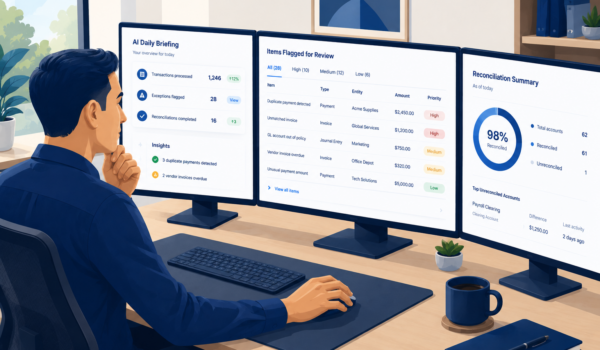
Agentic accounting is when AI agents handle the routine work of finance—billing, payables, cash application, reconciliation—and the CPA directs, reviews, and signs off. The audit trail, segregation of duties, and professional accountability stay with the human. Here’s what changes, what doesn’t, and where the profession is heading.
Share
Agentic accounting—also called the headless era of finance—marks a structural shift in the profession. Routine work like billing, payables, cash application, and reconciliation is moving from the accountant’s keyboard to AI agents, with the accountant directing and approving. Examples of AI in accountingshow how these changes are already being applied. What changes, what doesn’t, and where the profession is heading.
What’s shifting in accounting
For 30 years, accounting work has been defined by what accountants do with their hands. Keying journal entries. Creating customer billings line by line. Entering vendor invoices. Applying cash. Cutting checks. Matching bank transactions. The software changed—from green screens to cloud—but the work itself didn’t.
That era is ending.
Gartner projects that 40% of enterprise applications will have task-specific AI agents embedded by the end of 2026—up from less than 5% in 2025—and that 15% of day-to-day work decisions will be made autonomously by 2030. McKinsey estimates AI agents could perform work equivalent to 44% of US labor hours by 2030. For narrow, rules-based accounting work—the bulk of what a staff accountant or AP clerk does—that share trends higher. Routine, structured tasks automate first.
The accounting day, before and after
The traditional day. You open your accounting system. You create the day’s customer billings—line items, terms, taxes—by hand. You enter the vendor invoices that came in overnight. You apply customer payments that hit the bank, matching each one to an open invoice. You cut checks for what’s due this week. You record journal entries for accruals, depreciation, and intercompany. You build a custom report when the CFO asks how Q3 is trending. If something is off at close, you trace it back through the GL and start over.
The agentic day. You log in to your AI Daily Briefing. The AI accounting agent created today’s recurring customer billings overnight; you review three exceptions. Vendor invoices have been scanned, coded, and routed for approval. Cash received from customers has been auto-applied—two items couldn’t be matched and need your judgment. Bills due this week are queued for your approval. The bank reconciliation is at zero variance. The briefing also surfaces what’s drifting—DSO trending up, one entity’s accruals out of pattern, an intercompany elimination that failed. You spend the day on the exceptions, the judgment calls, and the conversation with the CFO about why DSO is moving.
Same books. A fraction of the manual work. The audit trail builds itself.
This is where finance teams are heading. Forward-leaning teams are starting to operate this way today; most aren’t there yet.
What is agentic accounting?
Agentic accounting—sometimes called headless accounting—means the accountant directs the work and AI agents perform the routine tasks. Headless doesn’t mean leaderless: you set the rules, the agents execute, and you review, approve, and sign off on the output.
Picture the operator of a modern production line versus the worker on an old one. The old worker turned wrenches, fitted parts, and ran the machines themselves. The modern operator monitors a control panel, intervenes when something deviates from spec, and decides what gets shipped. The work matters more, not less—but it’s a different kind of work.
That’s where accounting is heading. The CPA is the operator. The agents do the routine. The judgment, the controls, and the accountability stay with the human.
Before and after, at a glance
Traditional accountant
Agentic accountant
Posts journal entries by hand
Reviews AI-posted entries
Creates customer billings line by line
Agent generates billings; you review exceptions
Enters vendor invoices manually
Agent codes and routes invoices; you approve
Records customer payments and applies cash
Agent matches and applies; you review what doesn’t fit
Three things are non-negotiable in accounting, and agentic accounting doesn’t change any of them.
The audit trail. Every entry an AI agent posts carries a complete record—what it did, why, when, against what policy, and who approved it. Done well, agentic accounting produces a more thorough audit trail than a manual workflow ever did.
Segregation of duties. The agent posting an entry isn’t the entity approving it. Your existing approval hierarchies still hold. The system enforces them by policy.
Professional accountability. The CPA still signs off on the books. The CFO still attests. The auditor still issues an opinion. What the AI does, it does under your authority, against your rules. The buck still stops with the human professional.
If anything, the routine workload coming off your desk frees you to spend more time on the controls and judgment work that makes you accountable in the first place.
The mental model that makes agentic accounting work
You don’t need to write code, learn Python, or become a developer to work this way. You need a different mental model.
Think of yourself as a controller managing a team that never sleeps. The team is fast, precise, and tireless. It can post 47 journal entries in a minute, generate today’s recurring billings before you log in, or match 200 ACH payments before you finish your coffee. But the team only does what you tell it to do, against the rules you set. If your direction is vague, the output will be too. If your direction is clear, the output is exact.
Instead of asking “what’s the right journal entry for this transaction?”, you describe the economic event in plain English. The agent generates the entry. You review it against policy, approve it, and the audit trail builds itself.
Instead of building a custom report when finance asks “how is Q3 trending versus forecast?”, you ask the system in plain English. The answer comes back with every figure traceable to the underlying transactions.
The skill that distinguishes accountants in this era isn’t keystroke speed or report-building. It’s clarity, judgment, and the ability to direct.
Where agentic accounting is heading
Most finance teams aren’t there yet. Some are starting. The honest state of the profession in 2026: a growing share of CFOs and controllers want this future but haven’t found the path to get there—what platform to choose, where to start, how to handle the change in their teams.
The next several years will sort the firms that figured it out from the ones that didn’t. The firms that get there first will run with smaller, higher-leverage teams, faster closes, and more bandwidth for advisory work. The firms that don’t will compete on hourly rates with a workflow that doesn’t scale.
What makes an agentic accounting day possible isn’t the agents themselves. It’s running them inside a single source of truth—your accounting and your CRM on the same platform, governed by the same security model, with no second system to keep in sync. We’ve covered the architecture side of this shift separately in Salesforce Headless: What It Means for Your Finance Data.
The work isn’t going away. Wasted time in your day is.
Frequently asked questions about agentic accounting
What is agentic accounting?
Agentic accounting is a way of working in which AI agents handle the routine, rules-based tasks that have traditionally consumed an accountant’s day—creating customer billings, coding vendor invoices, applying cash, posting journal entries, running bank reconciliations, and answering finance questions in plain English. The accountant directs the system, reviews exceptions, approves what the agents have done, and owns the judgment calls. The CPA is still the operator, and professional accountability still rests with the human.
Does agentic accounting mean AI is replacing accountants?
No. Agentic accounting changes what an accountant does, not whether one is needed. The routine work moves to AI agents; the judgment, controls, audit responsibility, and professional sign-off stay with the CPA. Think of the shift like the move from production-line worker to production-line operator: the operator’s job is more important, not less, but the work itself looks different. Auditors still need auditors. CFOs still attest. The buck still stops with the human professional.
What does an accountant actually do in an agentic accounting model?
The accountant directs the system, reviews what the agents have done, and owns the exceptions and judgment calls. A typical agentic day looks like reviewing an AI daily briefing of what the agents completed overnight, approving payment runs and invoice coding, working through items that couldn’t be matched automatically, investigating anomalies the system surfaced (DSO drift, out-of-pattern accruals, failed eliminations), and spending more time on advisory conversations with the CFO. The accountant’s time shifts from data entry to oversight, analysis, and decision-making.
What stays the same in agentic accounting?
Three things don’t change: the audit trail, segregation of duties, and professional accountability. Every entry an agent creates or recommends should carry a complete record of what it did, why, when, against what policy, and who approved it—often more thoroughly than a manual workflow. Approval hierarchies still apply: the Controller still owns the close, the CFO still certifies, and the auditor still attests. AI acts under your authority, against your rules.
How do I start moving my finance team toward agentic accounting?
Start with where your financial data lives. AI agents can only do meaningful work if they can see a single, accurate source of financial data—and right now, only about a quarter of organizations have all their financial data in one system. The first step is consolidating that foundation: getting sales data, customer data, billing, AR, AP, and the GL onto the same platform, under the same security model. From there, identify one routine, high-volume task (cash application, recurring billings, or invoice coding are common starting points), turn an agent loose on it under tight approval rules, and measure the time you get back. Expand from there as the team builds confidence in the controls.
About the author
Jesse Bronson
Jesse is the Director of GTM Growth at Accounting Seed. He collaborates with finance professionals and industry experts to develop practical content for companies evaluating accounting technology. He works with subject matter experts to ensure technical accuracy while making complex accounting concepts accessible and actionable for finance teams at growth-stage organizations.
See Accounting Seed in action
See how accounting on Salesforce can eliminate the need for costly integrations—and silos of mismatched information—by sharing the same database as your CRM.