Back to Blog
For many finance teams, accounts receivable (AR) can feel like driving with a foggy windshield. You know the road, you’ve got the skills—but without clear visibility, every turn takes extra effort.
Manual spreadsheets and siloed systems, for example, limit visibility and make it nearly impossible to anticipate late payments or assess credit risk before it’s too late. Add the growing pressure to improve collections and accelerate cash flow, and an already complex job becomes a daily struggle against uncertainty.
The most effective way to clear the fog over accounts receivable and get ahead of these challenges is with receivables analytics software. This technology gives you a real-time view of customer payment patterns and credit risk, which helps you anticipate issues sooner before they impact cash flow. From a holistic view, it makes the AR journey a whole lot smoother.
What is receivables analytics software?
Receivables analytics software is designed to help finance teams streamline the billing cycle with automation and real-time data. These systems track, measure, and improve how quickly your business gets paid, giving you the ability to spot trends and take action before issues arise.
Instead of relying only on static reports or disconnected spreadsheets, receivables analytics software provides deeper insights into customer payment patterns, overdue trends, and credit risk. It significantly reduces manual effort more than traditional AR management.
On platforms like Accounting Seed, which is built natively on Salesforce, teams can automate billing, reconcile payments instantly, and see CRM and AR data in one unified system. This native integration means cleaner data inputs, more accurate reporting, and confidence from working with real-time information instead of potentially outdated numbers.
Why receivables analytics matters
Defining and understanding receivables analytics is only part of the story. The real benefits come from what it empowers finance teams to accomplish. By moving beyond static aging reports and disconnected spreadsheets, receivables analytics software gives you the visibility and control to manage the billing cycle proactively.
With the right technology in place, you gain:
- Better visibility into incoming cash flow and overall AR performance
- Earlier identification of high-risk customers and late or missed payments
- Smarter strategies to refine credit terms and collections outreach, made possible by data-backed insights
- Real-time clarity into payment patterns and performance—no manual digging required
- Reduced reliance on spreadsheets and fewer reporting delays
While these are the core benefits, keep in mind that not all solutions deliver equally. The difference between just tracking receivables and effectively managing them comes down to the features your software provides.
Key features to look for in receivables analytics software
When evaluating this type of software, here are the features that will have the biggest impact on your results:
- Real-time dashboards and reporting
- Automation capabilities
- Integration with existing systems
Let’s break down why each matters for your finance team.
Real-time dashboards & reporting
The trouble with static reports is that they’re always trying to catch-up with your actual data.
Pre-built reports make it easy to analyze payment trends, spot problem accounts early, and track overall AR performance metrics. With Accounting Seed, teams also get the ability to customizable reports through simple point-and-click tools. Teams can visualize their data exactly how they need it and adjust collection strategies quickly to make more informed decisions about where to focus their team’s efforts.
Automation capabilities
Manual tasks eat up valuable time that could be spent on strategic work. Automation tools built into receivables analytics software handle these repetitive actions for you.
Workflow rules can enable accountants to set invoices to send automatically, trigger reminders when payments are late, and reconcile incoming cash without manual entry. Simple automations add up to powerful outcomes: fewer delays, fewer errors, and more consistent follow-up, giving your team the bandwidth to manage higher volumes without adding headcount.
Integration with existing systems
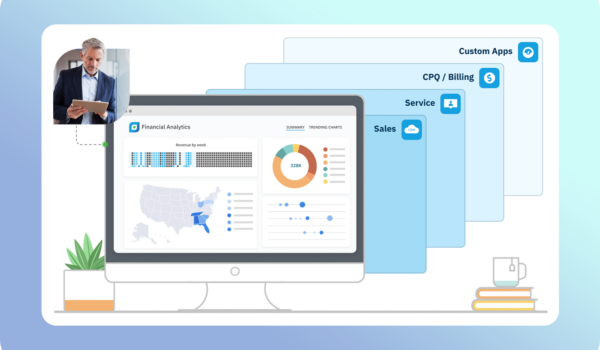
Disconnected systems often mean duplicate entries and missed details. Choosing receivables analytics software that integrates with your CRM creates a single source of truth for your entire company, so sales, service, and finance all work from the same data.
Because Accounting Seed is built directly on Salesforce, AR data lives alongside all your customer information. It also allows you to connect to any Salesforce cloud application, like Sales Cloud, Revenue Cloud, or Service Cloud, eliminating data silos and ensuring everyone has access to the same real-time information.
Recap: The main benefits of using receivables analytics software
We’ve covered a lot on the topic of receivables analytics software and its features. To recap, here are the key business benefits this technology brings:
- Faster collections and improved cash flow visibility
- Lower bad debt risk through early identification of high-risk accounts
- Smarter credit and collection decisions backed by real-time data
- More time for strategic analysis, thanks to automation
- Stronger customer relationships built on timely, transparent communication
But how do you make sure the software you choose actually delivers on these benefits? That’s where thoughtful evaluation comes in.
How to choose the right receivables analytics solution
Because there are many software options available, the best way to determine which is the best fit is to start with your specific business needs. This is an investment that will impact cash flow management across your entire organization. The right platform should fit seamlessly into your workflows—not force you to adapt to its limitations.
Key considerations when evaluating solutions:
- Assess your reporting and analytics requirements. If your team needs more than basic static aging reports, look for software with customizable dashboards and real-time analytics to track payment trends and uncover actionable insights.
- Prioritize real-time visibility. The ability to see overdue accounts, cash flow projections, and collection status instantly enables faster, more informed decision-making.
- Reduce manual work through automation. Choose a solution that automates repetitive tasks, like invoice generation and payment reminders, freeing your team to focus on higher-value activities.
- Assess integration with existing systems. The ideal solution brings AR, customer, and sales data together on one platform, eliminating third-party syncs, reducing errors, and ensuring data consistency.
While these considerations help you choose the right solution for today, it’s also worth looking ahead.
Future trends in receivables analytics
The world is moving fast, and the future is all about smarter, more connected tools, including receivables analytics software. Manual tracking is giving way to automation-first AR, where invoicing, reminders, and reconciliation happen automatically so teams can focus on strategy instead of busywork.
Finance leaders also want fewer siloed systems. Connected data ecosystems are becoming the standard with platforms that unify billing, payment processing, and reconciliation into one integrated system.
Customer experience is another key driver. Businesses are prioritizing flexible payment options, quicker dispute resolution, and transparent communication to strengthen relationships while accelerating cash flow.
Perhaps the most exciting trend is the expanding role of AI. Beyond automating repetitive tasks, AI-powered platforms are starting to analyze payment patterns, identify opportunities, and flag issues. Accounting Seed’s AI Accounting Agents exemplify this trend by helping teams prioritize collections, automate payment matching, and generate insights from financial data—all while keeping your team in control of strategic decisions.
See AR clearly with Accounting Seed
Receivables analytics software is no longer a nice-to-have—it’s essential for finance teams that want to stay competitive. With Accounting Seed, you get all the capabilities we’ve discussed on a truly Salesforce-native platform. Your AR, customer, and sales data live in one unified system, so you can automate routine tasks, analyze performance in real time, and scale operations without adding headcount.
Ready to clear the fog from your AR process? Schedule a demo.

See Accounting Seed in action
See how accounting on Salesforce can eliminate the need for costly integrations—and silos of mismatched information—by sharing the same database as your CRM.