2026 Industry Survey

The State of AI in Accounting

We surveyed 128 CFOs, controllers, IT administrators, and finance team members to understand how organizations are approaching AI adoption in accounting—and what’s standing in the way.

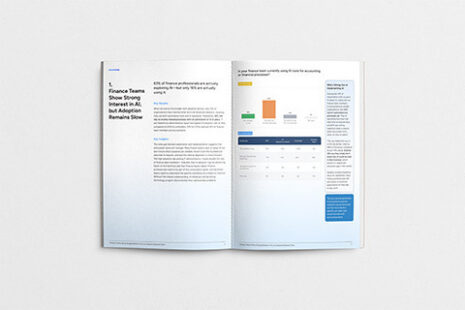
The findings point to a clear disconnect between interest and execution. While 63% of finance teams are exploring AI tools, only 16% have implemented AI in day-to-day accounting workflows. The gap isn’t skepticism about AI’s potential—it’s whether teams are operationally ready to use it.
What’s slowing AI adoption in accounting

Across roles and industries, respondents consistently cited foundational challenges rather than resistance to AI itself.

  • Financial data is spread across disconnected systems
  • Data quality issues reduce confidence in AI outputs
  • Manual work dominates day-to-day operations
  • Competing priorities push AI initiatives into the background

These issues make it difficult for teams to move beyond experimentation and into practical use.

Key findings from the 2026 survey

Findings are based on responses from 128 CFOs, controllers, IT administrators, and finance team members (December 2025–January 2026).

Adoption

Interest vs. implementation

Many teams are exploring AI, but far fewer have operationalized it with supporting automation.

63%

of finance teams are actively exploring AI tools

12%

report advanced adoption

Defined as having both automation and AI assistants in place.

Time & effort

Manual work remains the norm

The strongest pull for AI is time saved—because repetitive work still consumes a meaningful share of the week.

56%

of respondents want AI primarily to reduce time spent on repetitive tasks

84%

of finance teams spend at least 25% of their time on manual, repetitive work

Foundation

Data and integration barriers

AI adoption stalls when systems don’t connect and the underlying data can’t be trusted or unified.

34%

cite integration with existing systems as a barrier

  • 23% of organizations have all financial data in a single system
  • 20% operate across multiple disconnected systems
Process

Gaps in automation

Many organizations still haven’t automated core accounting work, which limits how useful AI can be in practice.

29%

of organizations haven’t automated any accounting processes

  • Among those who have automated: accounts payable (31%) and data entry (30%) are most common
Confidence

Trust and accuracy concerns

Skepticism is highest among the people accountable for financial accuracy day to day.

  • 35% of finance team members cite fear of errors or hallucinations
  • Only 11% of IT administrators cite accuracy as a barrier
Execution

Competing priorities

Even when interest exists, many teams are blocked by other initiatives taking precedence.

34%

of respondents say other initiatives are taking precedence over AI adoption

9%

say they’re actively moving forward with AI and have nothing blocking progress

Source: Accounting Seed 2026 AI in Accounting Industry Survey (December 2025–January 2026, n=128).

What this means for finance teams

AI adoption in accounting isn’t stalled because teams don’t see the value. It’s stalled because the underlying data, systems, and workflows aren’t ready to support it.

Organizations that unify financial data, reduce manual work, and integrate systems are far more likely to move AI from experimentation into practical, trusted use.

Ready to see where your organization stands?

Download the full report for complete survey findings, role-by-role breakdowns, and practical guidance on building the data foundation AI requires.

Download now

Survey details

This survey was conducted between December 2025 and January 2026. Respondents included CFOs, controllers, finance team members, and IT/Salesforce administrators from organizations across technology, nonprofit, professional services, healthcare, and manufacturing.