Executive education is one of the fastest-growing revenue lines on campus, and most university finance systems weren’t built for it. Learners pay upfront, programs launch and change quickly, and tying it all together often falls to one person and one spreadsheet.
That was the focus of our session, The Enrollment Cliff Survival Guide. Higher ed technology strategist Corey Snow and Rebecca Ralls, senior solutions architect at Coastal, joined Accounting Seed CEO Nasser Chanda and me to dig into where exec ed growth breaks, and how one top business school fixed it.
Key takeaways
- With fewer traditional-age students coming in, universities are turning to exec ed and professional learning, where demand keeps growing
- The first thing to break is usually the connection between systems, not the programs
- Bringing accounting into the room early prevents most of the rework
- Billing, refund, and revenue rules work best as settings the business can change, not custom code IT has to maintain
I started my career in accounting where I went through a major software adoption, moved into consulting where I was implementing accounting software for businesses, and now work on the product management side. So, I’ve sat on both sides of this table. I know what it feels like to get handed a new system that doesn’t match how you close, and I’ve been the one explaining to an accounting team why a system works the way it does. This conversation with Corey, Rebecca, and Nasser hit home for me.
Why is executive education becoming a growth engine for universities?
The traditional student pipeline is shrinking, and the adult learner pipeline isn’t.
Nasser opened with the number driving the conversation: “We expect a 13% decline in US high school graduates over the coming years.” That may not sound like much, he said, “but with the fixed cost that the university systems have, that’s a significant structural impairment.” His warning: “Hundreds of schools could close if they don’t shift.”
Corey’s time at Harvard shows what the alternative can look like. Across all its programs, Harvard generates about $2 billion from professional learning, he said. In 2018, its non-degree revenue passed degree revenue for the first time, and those programs had about a 14% compound annual growth rate.
Most schools aren’t Harvard, and Corey says they don’t need to be. “The main thing is competition isn’t really amongst the other programs. It’s more nonparticipation.” A school with a unique local industry, employer relationship, or specialty can build programs nobody else can offer.
The demand isn’t going away, either. “While there may be a shortage of eighteen- to twenty-four-year-olds, the good news is that the supply of professional learners approaches infinity,” Corey said. He pointed to Dr. Gary Matkin’s idea of the 60-year curriculum: “Someone graduating college today can expect to live a hundred years with a sixty-year working life… with eight to nine wholly distinct careers.”
What’s slowing exec ed programs down?
It’s usually speed and systems.
“Every dean I talk to, everywhere I go, is holding in their hand half a dozen new program ideas with high confidence that they could really fill them,” Corey said. The barrier is “how can I get from that idea to program faster and with less friction.”
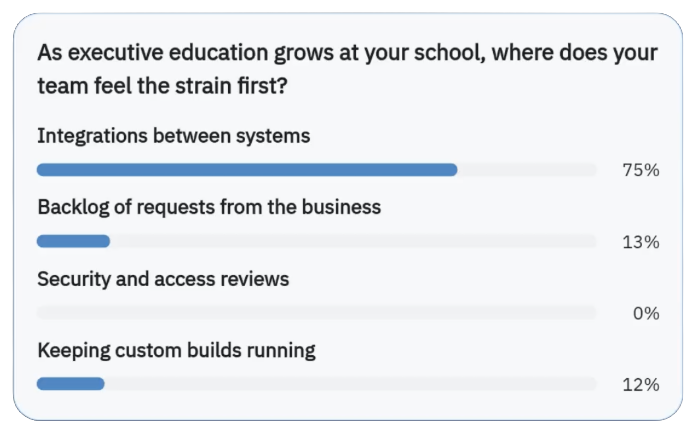
A lot of that friction comes from technology. I opened the session by asking attendees where exec ed growth hits their team first. Most picked the integrations between systems. Corey wasn’t surprised: “Even smaller programs often operate a dozen or more key systems.”
There’s usually a gap between the learner-facing tools and back-office finance, and a person filling it. “Often, there is that one person in the middle that runs the mission critical spreadsheet that glues all of this together,” Corey said. That holds up at low volume. It doesn’t once you’re adding cohorts, changing refund terms, and recognizing revenue across dozens of programs.
What do high-performing exec ed programs do differently?
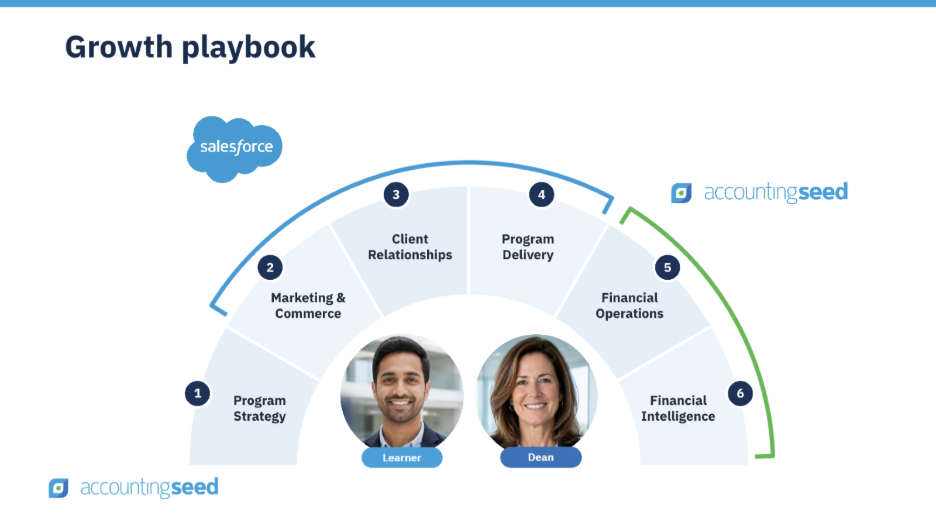
They get six capabilities working together instead of excelling at just one. Nasser walked through a growth playbook based on how hundreds of colleges expand:
- Program strategy, informed by market and financial data
- Marketing and commerce to reach learners
- Client relationships with learners and corporate partners
- Program delivery
- Financial operations
- Financial intelligence
The last two are where finance comes in, and they feed back into the first. If you can’t see which programs are growing and profitable, you can’t decide which ones to expand. “You can’t adjust if you don’t have your operations and your financials working in concert with each other, providing you visibility fast,” Nasser said.
He also called out schools doing parts of this well. Columbia Business School built 60-plus programs around its ties to the New York business community. Ivy Tech Community College in Indiana has more than 100 in-depth corporate partnerships and teaches 200,000-plus learners a year.
How one top business school got IT and accounting on the same page
Rebecca shared a project she led for a top business school with a fast-growing exec ed division. It ran adult professional courses, noncredit programs, and summer certificates, with “a lot of transaction volume. And most of the accounting was being managed in spreadsheets.”
IT saw the risk early. “They took the initiative and found a platform that could grow with them,” Rebecca said, but “accounting hadn’t really been part of those early conversations.” The first setup was built on IT’s best guess at what finance needed. “It was a textbook case of two teams speaking completely different languages and not communicating effectively.”
Coastal’s job was to translate. They ran joint working sessions so each team heard the other’s reasoning directly, not through tickets and emails.
The core accounting need was easy to say and hard to get right. “Executive students pay upfront, but the courses happen later, which means the money can’t be counted as revenue until the course is complete.” Once the teams mapped what accounting needed at month-end, Rebecca said, “everything they needed was already in the system… It was really just about configuring it the right way.”
Configure the rules. Don’t code them.
The design rested on one idea: business rules that usually live in code, or in someone’s head, became settings accounting can change.
- Revenue templates define how money flows for a course, like whether it needs a deposit or splits revenue between tuition and room and board. “You set that up once, and every course that uses that template follows it.”
- Program policies work like “a self-service rules engine for each course”: cancellation fees, transfer penalties, refund schedules, and billing terms. “All of it is point and click.”
- Automated revenue recognition creates an entry for each approved, fully paid application, dated to the course end date. At month-end, accounting reviews what posted instead of chasing which courses ended and building journal entries by hand.
- Chart of accounts mapping translates accounts in Salesforce to the university’s central ERP, so the month-end export is a report, not a spreadsheet exercise.
Every transaction also ties back to the Salesforce record that created it. “When finance asks where did this number come from, they can trace it themselves instead of filing a ticket.”
What IT didn’t have to build mattered just as much. “We didn’t have to do any custom API code. We didn’t need a middleware layer, no ETL jobs, and no new vendor environment to secure,” Rebecca said. In plain terms, there were no extra integration tools to buy, build, or maintain. That list matters, because every one of these is something IT would otherwise have to build, secure, and maintain forever.
Now, when exec ed launches a cohort with its own refund terms, accounting sets it up without a ticket, and IT keeps control of architecture and security. Corey’s summary: “IT can be the hero in the story… with less heroics.”
Where should a university start?
Each panelist gave a version of the same answer: start aligned, and start small.
- Rebecca: “Don’t build in a silo. Make sure that the people who are going to be using the system are part of the conversation on how to build the system.”
- Corey: Start with “a purposeful strategy.” Many exec ed systems grew piece by piece while the program was small. Tie the technology plan to goals you can measure, like enrollments or new program launches.
- Nasser: Treat exec ed as “a separate business unit with its own system, with its own reporting.” For administrators making the case internally: “Prove one case study… start small, small investments, quick wins.”
Frequently asked questions
What is the enrollment cliff?
It’s the projected drop in U.S. high school graduates over the coming years, which means fewer traditional-age college students. Nasser cited a 13% decline.
How should universities handle exec ed tuition that’s paid upfront?
The money can’t count as revenue until the course is complete. In Rebecca’s project, each approved, fully paid application created a revenue recognition entry dated to the course end date, so month-end became a review instead of a rebuild.
Do you need middleware to connect exec ed finance to the university ERP?
Not in this case. Accounts in Salesforce were mapped to the ERP’s chart of accounts, and the month-end export ran as a report already in the ERP’s format. No middleware or ETL jobs were needed.
Who should be involved in an exec ed finance system project?
IT and accounting, from the start, plus the program teams who set course rules.
Watch the full conversation
The full session runs about 45 minutes, including audience Q&A. Watch it on demand →
If this sounds familiar, and you’re the one holding the spreadsheet together, I’d love to hear what your version of this looks like. Every school’s setup is a little different. Book a short, no-pressure conversation → Bring your finance team along.